

The internet didn't change marketing.
It made bad marketing impossible to hide.
Every fundamental principle of good marketing was true before the internet existed. The web didn't rewrite the rules. It just removed the places to hide when you ignored them.

The illusion of the "new era"
Pick up any marketing book written after 2005 and you'll find some version of the same claim: the internet changed everything. New rules. New consumers. A new game entirely.
It didn't. Not really.
David Ogilvy was writing about the importance of trust and honesty in advertising in the 1960s. In Ogilvy on Advertising (1983), he argued that the consumer is not a moron; she's your wife. His point was simple: talk down to people, mislead them, or bore them, and they'll tune you out. That was true when the only channel was a print ad. It's still true now.
What the internet changed is the speed and scale of consequences. A bad campaign used to fade quietly. Now it gets screenshotted, shared, and turned into a case study in what not to do. The principles stayed the same. The stakes got higher.
"Consumers are not stupid. They just had fewer ways to tell you about it."
Reputation has always been the product
Long before Google reviews existed, businesses lived and died by word of mouth. In 1955, sociologist Everett Rogers published his foundational research on how ideas and products spread through social networks (later codified in Diffusion of Innovations). His core finding: people trust people. Peer recommendation has always outperformed paid promotion.
The internet didn't create that dynamic. It amplified it by several orders of magnitude. A satisfied customer in 1975 might tell eight to ten people. Research from the Wharton School puts the modern digital equivalent closer to several hundred, depending on network size and platform.
Brands that understood this before the internet are the same ones that adapted well to it. Patagonia built its entire identity around a genuine commitment to environmental responsibility going back to the 1970s. When social media arrived, they didn't need a new strategy. They already had one.
What "bad marketing" actually means
Bad marketing isn't just ugly ads or clunky copy. Robert Cialdini's research on influence, published in 1984 and still widely cited, identified six core principles of persuasion: reciprocity, commitment, social proof, authority, liking, and scarcity. The problem isn't the principles themselves. It's when marketers weaponize them against the very customers they're trying to serve.
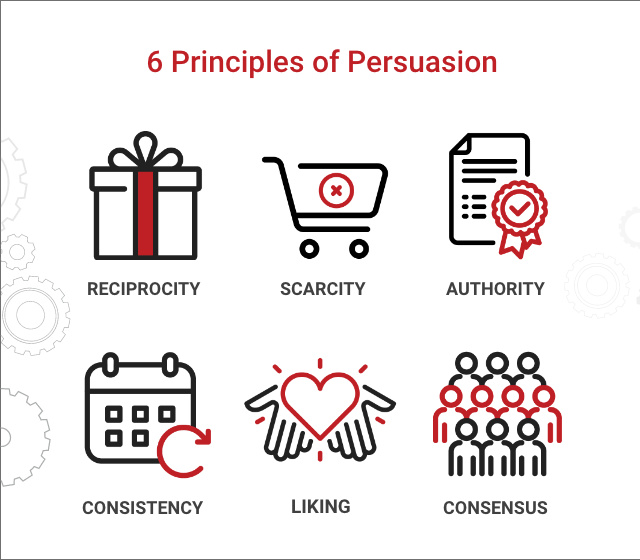
Influence at Work
Think about every dark pattern you've encountered online. The countdown timer that resets. The "only 3 left" notification on an item that's always in stock. The unsubscribe link buried three menus deep. Each of those borrows from Cialdini's playbook. Each of them also erodes trust the moment a customer figures out the trick. And they figure it out.
A 2019 study by Mathur et al. at Princeton and the University of Chicago identified 1,818 dark patterns across 11,000 shopping websites. These weren't fringe operators. Several were household names. The fact that these patterns are cataloged, studied, and publicly reported tells you everything about how well the internet hides them.
The search bar changed everything about credibility
There's one genuinely new dynamic the internet introduced, and it matters more than most marketers acknowledge: the ability to verify claims instantly.
Before search engines, a brand could say almost anything. "Trusted by millions." "The world's best." Consumers had limited options for checking. Now they have unlimited ones. A claim takes three seconds to verify or debunk. A competitor's reviews are one tab away. A journalist's investigation from two years ago still ranks on page one.
This isn't just about obvious lies. It's about the gap between what a brand projects and what it actually delivers. Marketing researchers Fournier and Avery described this as the "open brand" problem in a 2011 paper in the Journal of Consumer Psychology: in the social media era, brands no longer fully control their own narratives. Customers do. The brand you think you're projecting and the brand your customers experience may be two entirely different things, and now everyone can see both.
The brand you project and the brand your customers experience are often two very different things. The internet just makes sure everyone can see both.
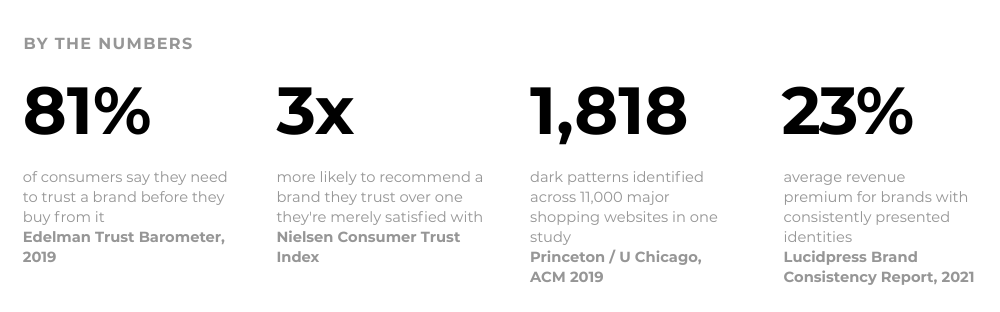
Consistency was always the core discipline
Brand consistency isn't a concept the internet invented. It's been a foundational principle of brand management since at least the 1950s, when Burleigh Gardner and Sidney Levy first wrote about brand image in the Harvard Business Review (1955). Their argument: consumers build mental models of brands, and every interaction either reinforces or degrades that model.
What's different now is that those interactions happen across more surfaces, more simultaneously, and with longer memory. A tweet from 2012 is still findable. A customer service complaint from three years ago still indexes. The brand consistency you failed to maintain in 2019 can still show up in a potential client's research call today.
This is why a coherent digital presence isn't a nice-to-have. It's table stakes. A company with a polished website and a neglected LinkedIn, a clear brand voice in email and a different one on Instagram, isn't just inconsistent. It's signaling that it doesn't pay attention. That signal is loud.
Why "growth hacking" is the wrong frame
The term "growth hacking" was coined by Sean Ellis in 2010. The idea was to find fast, low-cost ways to acquire users, usually by exploiting platform-specific loopholes or optimizing conversion at every step. For early-stage startups optimizing for raw user acquisition, some of it made sense. For building a brand, it's largely counterproductive.
Tactics that optimize for short-term clicks tend to optimize away from long-term trust. And trust, as Cialdini and decades of subsequent consumer psychology research confirm, is the actual driver of repeat purchase, referral, and lifetime value.
A 2015 study published in the Journal of Marketing found that brand trust was a stronger predictor of customer loyalty than satisfaction in 19 out of 24 product categories studied. Satisfaction matters. Trust matters more. You can't hack your way to trust.
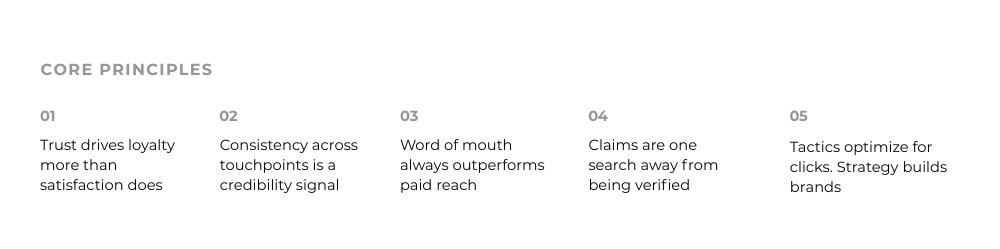
What this means for how you build your brand online
None of this is a reason to despair. It's a reason to take the fundamentals seriously, because they compound over time in a way tactics never do.
A consistent brand identity, built on an honest positioning, communicated clearly across every digital touchpoint, and backed by a service experience that matches the promise — that's still the whole game. It was the whole game in 1960. It's the whole game now.
The internet just accelerated the feedback loop. Bad marketing used to take years to catch up with you. Now it takes weeks. Good marketing used to build slowly. Now it builds faster, because people share what they trust and recommend what they respect.
The brands worth paying attention to have always understood this. They didn't panic when social media arrived, or when AI started writing ad copy, or when the algorithm changed again. They didn't need to. They were playing a different game to begin with.