

The word "brand" gets used hundreds of times a day by marketers, executives, and consultants. Most of them mean something slightly different. Here is what the evidence actually says.

What makes a brand?
Ask five marketing professionals what a brand is and you will get five different answers. One will say it is your logo. Another will say it is your reputation. A third will quote Marty Neumeier and tell you it is "a gut feeling." The fourth will point to your brand guidelines PDF. The fifth will say something about "storytelling" and you will politely move on.
None of them are entirely wrong. But none of them are giving you the complete picture, either. And when something as foundational as this is poorly understood, the decisions that follow tend to be poorly made.
Where the word actually came from
The concept of branding is genuinely ancient. Norse and Old English traders used the word "brandr," meaning to burn, to describe how livestock were marked to show ownership. That is not a metaphor. It was a practical system of identification in markets where trust depended on knowing exactly who stood behind a product.
The industrial revolution scaled this logic. When a consumer in 1890 picked up a bar of Ivory soap, the Procter & Gamble name on the wrapper was a shortcut. It told them something reliable about what was inside. This is when branding shifted from a mark of ownership to a signal of consistent quality. The wrapper was not the product. It was a promise about the product.
"A brand is a name, term, sign, symbol, or design... intended to identify the goods and services of one seller and to differentiate them from those of competitors."
American Marketing Association, definition adopted 1960
This definition held up reasonably well for several decades. It focused on identification and differentiation, which are genuinely useful things. The problem is that it treats a brand as something a company creates and applies to a product. It puts the company in the driver's seat.
The shift that changed everything
By the 1980s, researchers started noticing something that challenged this company-centric view. Consumers were not just identifying products by brand names. They were forming emotional relationships with them. They were making irrational purchasing decisions based on brand associations that had little to do with the product itself.
A study by Allison and Uhl published in the Journal of Marketing Research in 1964 had already hinted at this. Participants who drank beer without labels gave fairly neutral ratings. When labels were added, their ratings shifted dramatically, even though the liquid was identical. The brand, not the product, was shaping the experience.
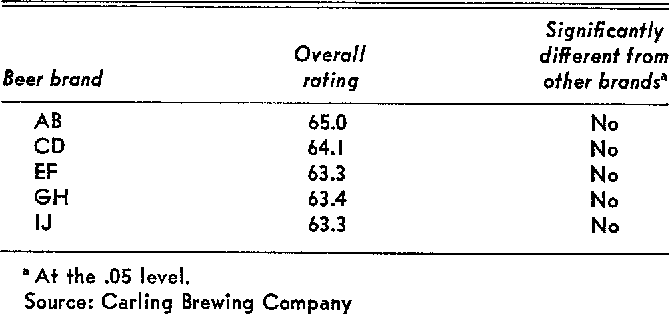
Ralph I. Allison, Kenneth P. Uhl | Published 1 August 1964 | Journal of Marketing Research
David Aaker formalized this thinking in his 1991 book Managing Brand Equity. He introduced the concept of brand equity, which is the additional value a brand name adds to a product beyond its functional benefits. A product and a brand are not the same thing. A product can be copied. A brand, if built correctly, cannot.
A note on sources: Aaker's framework remains widely cited in both academic and practitioner literature. Kevin Lane Keller's Strategic Brand Management (1998, revised 2013) expanded this into the Customer-Based Brand Equity model, which is probably the most rigorous framework currently in use. These are not pop-business books. They are grounded in decades of consumer behavior research.
So what is a brand, precisely?
Here is the most precise way to say it, drawing from Keller's model: a brand exists in the minds of consumers. It is the sum of all associations, beliefs, feelings, perceptions, and memories that a person holds about a company, product, or person. You cannot touch a brand. You can only touch the artifacts that influence it.
Your logo influences it. Your website influences it. Your customer service influences it. The price point influences it. The people who visibly use your product influence it. The way your CEO speaks in public influences it. Every signal you send, intentionally or not, feeds into the mental model your audience builds about you.
This is why the "gut feeling" description is not wrong, just incomplete. Neumeier's The Brand Gap (2003) captures the consumer-side truth accurately. But it skips over the mechanisms that create that feeling, which is where the real strategic work happens.
A brand is not what you say it is. It is what they think it is. The gap between those two things is where most brand problems live.
The three things a brand actually does
When researchers study what brands functionally do for consumers, three things come up consistently across the literature.
First, brands reduce the cognitive load of decisions. A 2010 study by Hoyer and Brown in the Journal of Consumer Research showed that consumers presented with familiar brands resolved purchasing decisions faster and with less information-seeking than consumers presented with unfamiliar options, even when the unfamiliar option was objectively superior. The brand acts as a decision shortcut. This is why being known matters before being chosen.
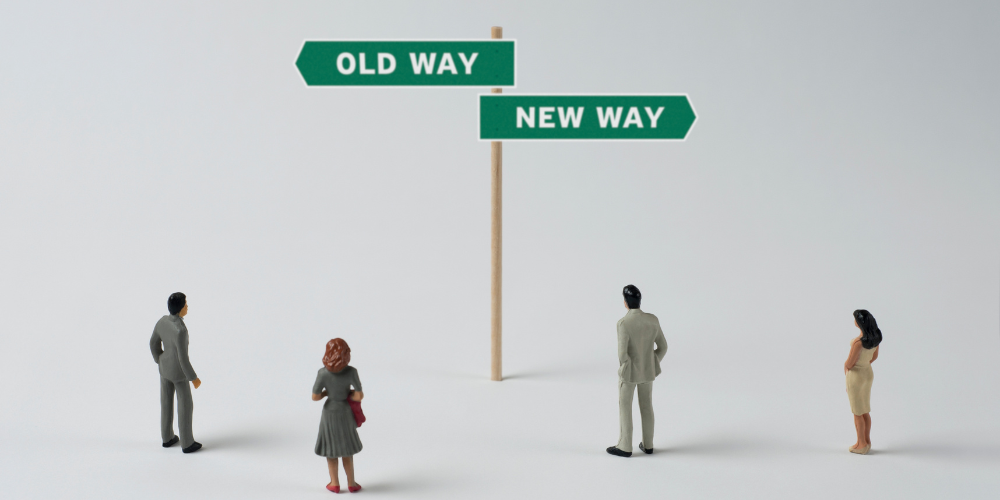
When choosing between 2 options, most people will go with the familiar one, even if the new one is superior.
Second, brands signal quality and reduce perceived risk. This is the original Procter & Gamble logic, and it still holds. When a consumer cannot fully evaluate a product before buying it, which covers almost every service business, a strong brand substitutes for the direct evidence they cannot access. Credibility and trust are not soft concepts. They are functional tools that convert skeptical strangers into first-time buyers.
“…a strong brand substitutes for the direct evidence they cannot access.”
Third, brands communicate identity. Consumers use brands to signal things about themselves to others and to reinforce their own self-concept. This is well-documented in the consumer psychology literature, particularly in work by Jennifer Aaker (1997) on brand personality dimensions and by Escalas and Bettman (2003) on self-brand connections. When someone drives a certain car or carries a certain bag or works with a certain agency, they are also saying something about who they are. This dynamic does not disappear in B2B markets. It just gets applied to professional identity rather than social identity.
What this means for digital branding specifically
The internet did not change what a brand is. It changed how rapidly and how visibly brand associations form and break down. In a physical retail environment, you controlled a relatively small number of brand touchpoints. Online, the number is effectively limitless, and most of them happen without your involvement.
A LinkedIn comment you made in 2021 is a brand touchpoint. A Google review from a disappointed client is a brand touchpoint. The speed of your website is a brand touchpoint. The font on your homepage is a brand touchpoint. Not because design is trivial, but because every signal contributes to the mental model your audience is constantly updating.
Consistency matters here for a specific psychological reason. Cognitive consistency theory, originating with Festinger's work on cognitive dissonance in 1957, explains why people become uncomfortable when they encounter contradictory signals from the same source. When a brand's visual identity is polished but its email responses are careless, that contradiction creates a small but real feeling of unease. Over time, these inconsistencies erode trust in ways that are hard to trace back to a single cause.
One concrete example: Edelman's annual Trust Barometer has consistently found, across its 20-plus year run, that trust is a primary driver of brand choice, particularly for new customers who lack direct experience with a company. The 2023 edition reported that 71% of respondents said trusting a brand is more important to them now than in the past. Trust is not a byproduct of a good brand. It is a core output you are actively building or eroding with every touchpoint.
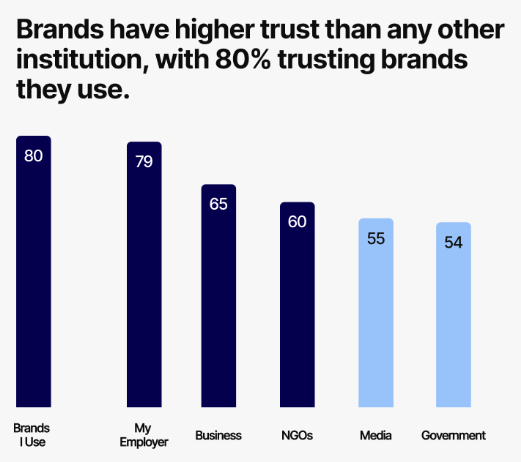
2025 Edelman Trust Barometer
The part most companies skip
Understanding what a brand is at the conceptual level is only useful if it changes how you make decisions. The practical implication is this: you cannot build a brand from the outside in. You cannot write a positioning statement and then reverse-engineer authentic behavior from it. People notice, and they remember.
The most durable brands in the research literature, whether you look at Millward Brown's BrandZ data or the academic work on brand longevity by Keller and Lehmann, share a consistent characteristic. They are built from a genuine organizational identity outward. The brand expresses something true about the company's values, point of view, and way of operating. This is not idealism. It is a practical observation about what lasts.
In his 1955 essay "The Product and the Brand," Burleigh Gardner noted that products are made in a factory, but brands are made in the mind. That quote is seventy years old. It has not aged.
The short answer
A brand is the mental representation your audience holds of your company. You shape it through consistent behavior, clear communication, and deliberate design of every signal you send into the world. You do not own it. They do. Your job is to give them good reasons to build it the way you intend.
Everything else, the logo, the tagline, the color palette, the tone of voice, is infrastructure. Valuable infrastructure, but not the thing itself. The thing itself lives in someone else's head, which is either a humbling thought or a clarifying one, depending on how you look at it.