

Why we judge businesses the same way we judge people.
Here's what that means for your brand.

When you meet someone at a dinner party and they spend the whole evening talking about themselves, you don't trust them. You just feel sold to. Your customers feel the same thing when they land on your website.
The brain doesn't distinguish between people and brands
In 2007, a team of researchers at UCLA led by Matthew Lieberman published a study showing that the same region of the brain, the medial prefrontal cortex, activates when people evaluate other humans and when they evaluate brands. We don't have a separate cognitive process for "thinking about companies." We apply the same social circuitry we use to size up a stranger at a party.
This isn't a metaphor. It's measurable neural activity. And it has consequences for how every aspect of your brand is perceived, from your website copy to your response time on email.
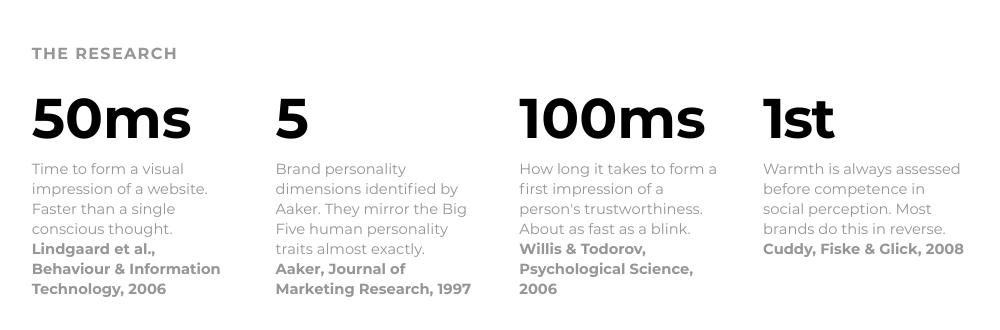
The field of brand personality research dates to work by Jennifer Aaker at Stanford, whose 1997 paper in the Journal of Marketing Research identified five stable dimensions along which consumers rate brands: sincerity, excitement, competence, sophistication, and ruggedness. These aren't arbitrary. They map almost directly onto the Big Five personality traits used in human psychology research. We rate Patagonia the way we rate a dependable, outdoorsy friend. We rate Apple the way we rate a brilliant, slightly intense colleague. The mental process is the same.
First impressions work the same way
In person, we form a first impression of someone in roughly 100 milliseconds. That's a finding from research by Janine Willis and Alexander Todorov at Princeton (2006), published in Psychological Science. We judge trustworthiness, competence, and likeability almost instantly, and those initial judgments are hard to revise later.
Digital environments are no different. Research by Gitte Lindgaard and colleagues at Carleton University, published in Behaviour & Information Technology in 2006, found that users form visual impressions of websites in 50 milliseconds. Fifty. That's faster than you can consciously process anything. The visual design, the layout, the whitespace, the typography — they all register as a "type of person" before a single word gets read.
This is why saying "our website just needs to function" is a bit like saying "I just need to show up to the job interview." Yes, technically. But the person across the table is already drawing conclusions.
Visual design registers as character before a single word gets read. Your website doesn't just communicate what you do. It communicates who you are.
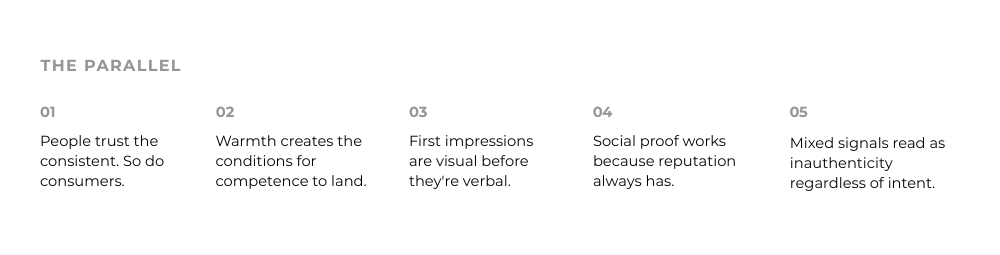
We trust consistency in people. We trust it in brands, too.
Think about the people you genuinely trust. Chances are, they behave the same way whether they're with you, with their boss, or with a stranger. Consistency is how humans signal authenticity. Inconsistency, on the other hand, reads as a red flag. If someone acts differently depending on who's watching, most of us start wondering which version is real.
Brands work exactly the same way. A 2012 study by Erdem and Swait, published in the Journal of Consumer Research, found that brand credibility, defined as the perceived trustworthiness and expertise of a brand, depended heavily on signal consistency across touchpoints. When a brand's visual identity, tone of voice, messaging, and service experience all pointed in the same direction, consumers rated it as significantly more credible. When those signals conflicted, credibility dropped regardless of what any individual touchpoint said.
A polished website paired with a generic, jargon-heavy LinkedIn sends a mixed signal. A confident brand voice on your homepage and an overly casual one in your email follow-ups does the same. Customers notice these gaps, often without being able to name what feels off. They just feel it.
Warmth before competence. Always.
Amy Cuddy, Susan Fiske, and Peter Glick published a series of studies between 2008 and 2013 examining how people evaluate others socially. Their central finding: warmth is assessed before competence, every time. We want to know if we can trust someone before we care whether they're capable. A highly competent person perceived as cold is viewed with suspicion, not admiration.
Most businesses get this backwards. Their websites lead with credentials, awards, and technical capabilities. "We've been in business for 22 years. We are industry leaders. Our proprietary methodology delivers results." All competence, no warmth. To a visitor's brain, that reads less like confidence and more like someone who showed up to a first date with a resume.
The brands that communicate most effectively lead with what they understand about you before they tell you what they can do for you. They demonstrate empathy first. The competence follows, and it lands better because of it.
We decide if we like someone before we decide if we respect them. Your brand should understand this sequence and work with it, not against it.
Reputation is a social signal, not just a record
When we decide whether to trust a person we've never met, we look for social proof. Who do they know? What do people say about them? Have they been vouched for? This isn't shallow. It's a rational heuristic for reducing uncertainty when you lack direct experience.
Consumer psychology research has documented this behavior in commercial contexts for decades. Robert Cialdini's original work on social proof (1984) showed that people use the behavior and opinions of others as a primary input in their own decision-making, particularly when they're uncertain. The internet didn't invent this. It just scaled it up dramatically and made it permanent.
A brand with strong social proof, meaning genuine client testimonials, case studies with real outcomes, visible professional associations, and consistent third-party mentions, is doing the digital equivalent of having a strong personal reputation in a small town. People have heard good things. That shapes how they approach you before you've said a word.
The inverse is equally true. Thin social proof reads like someone who's new to town and doesn't know anyone. You might be perfectly qualified. But the absence of vouching creates doubt that credentials alone can't resolve.
What this actually means for how you build your brand online
None of this is abstract. If people apply the same psychological machinery to brands that they use for people, then the principles of good brand-building map directly onto the principles of being a trustworthy, likeable, credible human being.
Be consistent. Show up the same way whether it's your website, your social presence, or your email signature. Don't be one person in your copy and someone else in your follow-up call.
Lead with empathy. Show that you understand your client's situation before you explain how you solve it. This isn't a copywriting trick. It's how trust actually forms between people, and it works because the brain responds to it the same way.
Make your warmth as visible as your competence. Let your expertise speak, but don't let it speak first. Case studies, results, and credentials matter. They just land better when the person reading them already feels understood.
Maintain your reputation actively. Collect real testimonials. Get specific about outcomes. Be present in the communities your clients trust. Social proof isn't a vanity metric. It's the digital equivalent of having a credible reputation, and it does more quiet work than almost any other element of your brand.
The businesses that get this right don't feel like businesses at all. They feel like someone worth knowing. That's not an accident. And it's not a coincidence that those are the businesses people refer, return to, and trust without much convincing.